UHT Milk Manufacturing
UHT is unforgiving on sterility and packaging economics. Both decide whether long shelf life becomes a commercial advantage or a stranded asset. The process itself is well understood; the commercial failures come from packaging cost per litre, uneconomic run lengths, distribution that never materialised, and sterility incidents whose true cost is measured in market confidence rather than in discarded product. An expansion case should be tested against all four before equipment is specified.
9 minute read
What this covers
- Sterility assurance and process control
- Packaging format and cost per litre
- Shelf life, distribution and export reach
- Capacity, run length and changeover
- Readiness before commissioning
Detail
Process and sterility
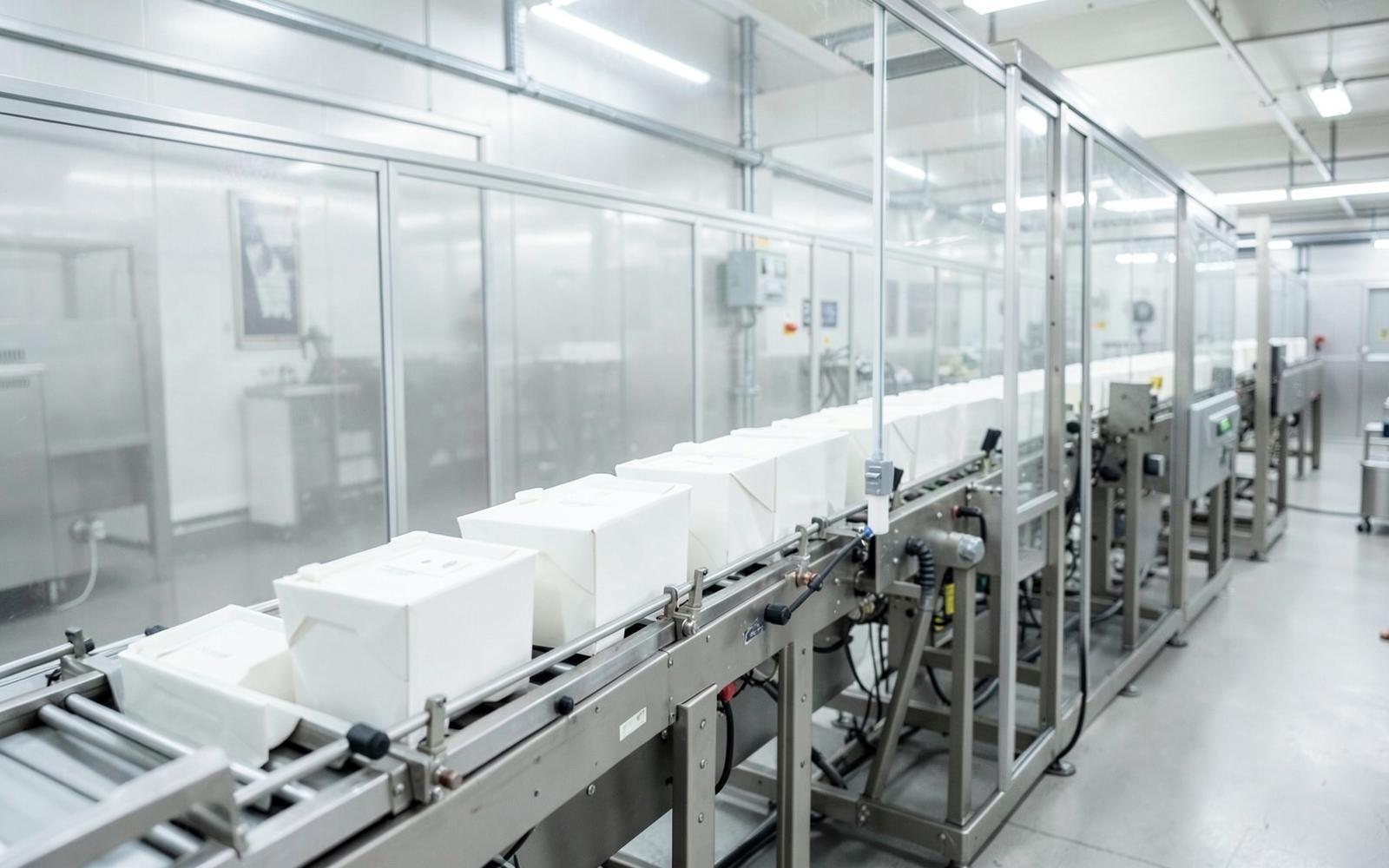
Sterility assurance in UHT depends on thermal treatment, aseptic zone integrity, sterile air, packaging material handling and the discipline around start-up, product change and short stops. The commercial requirement is a control system that detects failure before product reaches trade: incubation regimes, hold-and-release discipline, trend monitoring and clear release authority. A single non-sterile batch in market costs more than a year of packaging savings.
Packaging economics
In long-life milk, packaging is often the largest single cost after raw milk. Format, board or film specification, straw and closure choice, case configuration and supplier terms move cost per litre materially. Compare formats on landed cost per litre delivered to the customer, including secondary packaging, pallet efficiency and damage rates, not on unit price alone. Supplier concentration is a commercial risk in its own right.
Distribution and shelf life
Long shelf life only pays where it opens distribution the business can actually serve: distant domestic regions, export markets, or channels that cannot support chilled logistics. Test the route to market with the same rigour as the process. Registration timelines, labelling requirements, distributor capability, listing dates and payment behaviour all decide whether the ramp-up assumption is realistic.
Capacity planning and run length
Aseptic lines reward long runs. Every product or format change consumes sterilisation and validation time, and short runs quickly destroy the economics assumed in the business case. Model the planned SKU range against realistic run lengths and available hours. If the commercial plan requires many small runs, the line specification or the plan needs to change.
Readiness before start-up
Aseptic start-up exposes weaknesses in utilities, water quality, training and maintenance capability. A readiness review before commissioning — covering utility stability, spares, operator competence, laboratory capacity and release process — is far cheaper than discovering the gaps during validation runs with customers waiting.
Questions worth answering internally
If these cannot be answered with evidence, the decision is not yet ready.
- What is our packaging cost per litre versus the market?
- How is sterility failure detected and contained?
- Does shelf life open real export demand, or theoretical demand?
- What run length makes the line economic?
- Are we ready to commission, or only ready to install?
Planning a food or dairy manufacturing facility?
A short confidential discussion to understand your project, decision or operating challenge, confirm fit, and agree the most appropriate next step.
See the level of analysis before you engage.
The sample Margin & EBITDA review shows the structure, evidence and depth of a private written review. It is open to read, with no sign-up.
Continue
Operating judgment for food, dairy and manufacturing decisions.
Anonymised advisory patterns and illustrative examples.
See the depth and format of a private written review.
Executive Brief, Boardroom Review and Strategic Decision Memo.
A short confidential discussion to confirm fit and agree the right next step.