Food Production Line Efficiency: Bottlenecks, Labour, Waste and Throughput
Most food production lines hold more output than the business believes, and the gap is rarely where management expects. Throughput is lost in small increments: minor stops nobody records, changeovers that vary by crew, start-up waste accepted as normal, labour deployed to cover a chronic fault, and a bottleneck that has quietly moved since the last investment. Finding that output is cheaper than buying it, and it changes the capital conversation entirely.
9 minute read
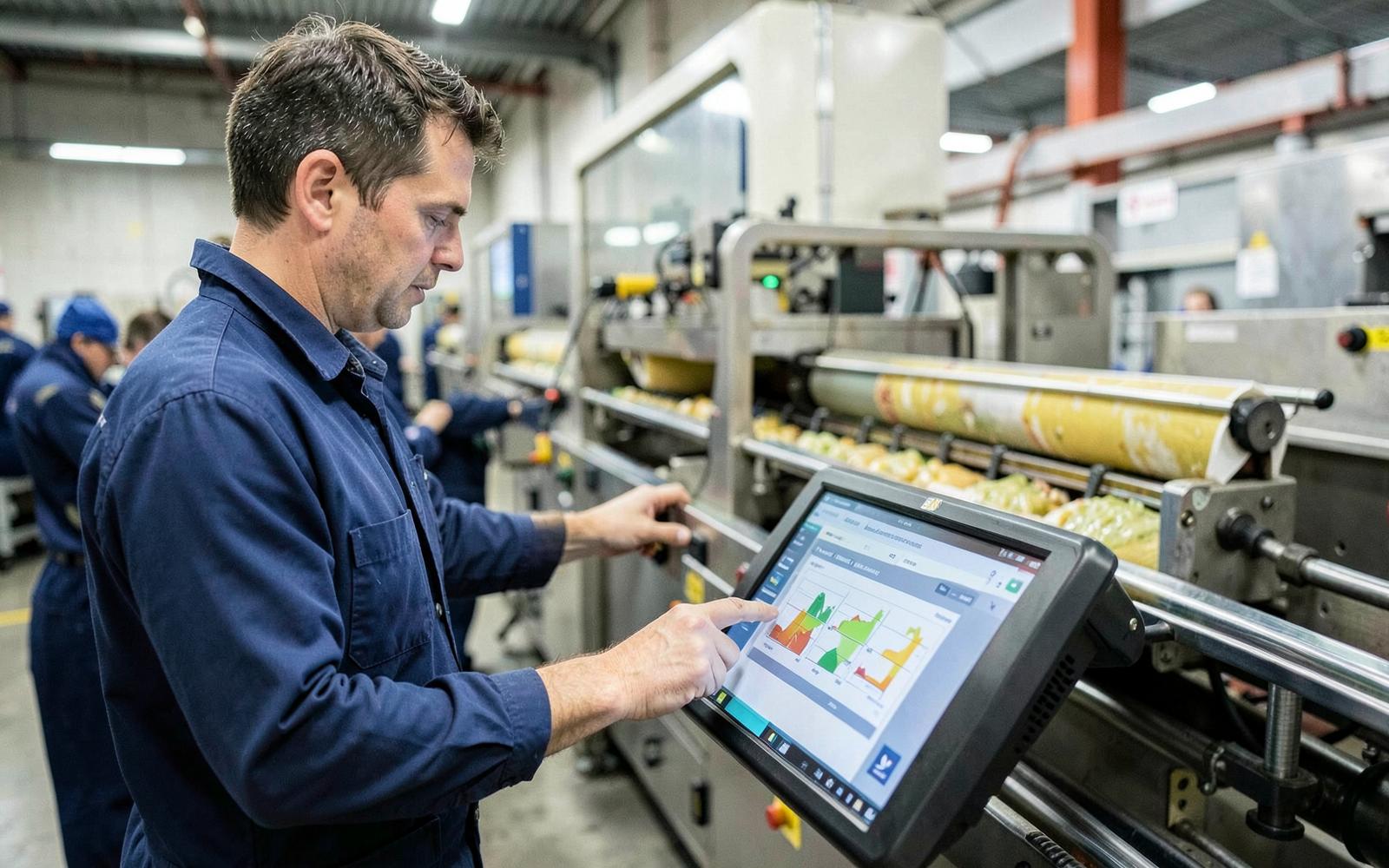
What this covers
- Identifying the true constraint
- Minor stops and the measurement gap
- Changeover variation between crews
- Labour deployment and line balance
- Making gains durable
Detail
Finding the constraint
Observe the line during a normal shift rather than a demonstration run. Time the slowest step, watch where product accumulates and where the line starves, and check whether upstream equipment is being run below capability to protect a downstream problem. Bottlenecks move after every change; a constraint identified two years ago is unlikely to be the current one.
Minor stops and measurement
Stops under a few minutes usually go unrecorded and often represent the largest single loss. Where recording depends on operator entry, the data will understate them. Even a short period of direct observation, or automatic capture at the constraint, typically reveals a materially different picture from the reported figures — and gives the improvement work a real target.
Changeover variation
Compare changeover times by crew, by shift and by format. Wide variation is good news: it means the fastest observed time is achievable and the work is standardisation, not investment. Document the best sequence, prepare kits and change parts, and treat changeover as a timed operation with an owner.
Labour and line balance
Labour is often deployed to compensate for an unsolved technical fault: someone re-feeding a reject, straightening packs, or handling manually because a device is unreliable. Those roles become permanent and invisible. List every task that exists because equipment does not work properly, then fix the cause and redeploy the labour.
Making gains durable
Throughput gains decay without a short daily performance routine: measured output at the constraint, top losses, one action, one owner. Where improvement depends on a project team rather than on the line's own routine, performance returns to baseline within a quarter of the team leaving.
Questions worth answering internally
If these cannot be answered with evidence, the decision is not yet ready.
- Where is the constraint today, on evidence?
- What is our real loss from stops under five minutes?
- What is the fastest changeover ever achieved here?
- How many people are covering for equipment problems?
- Will this gain survive without the project team?
Continue
Operating judgment for food, dairy and manufacturing decisions.
Anonymised advisory patterns and illustrative examples.
See the depth and format of a private written review.
Executive Brief, Boardroom Review and Strategic Decision Memo.
Senior operators applying to contribute to private reviews.